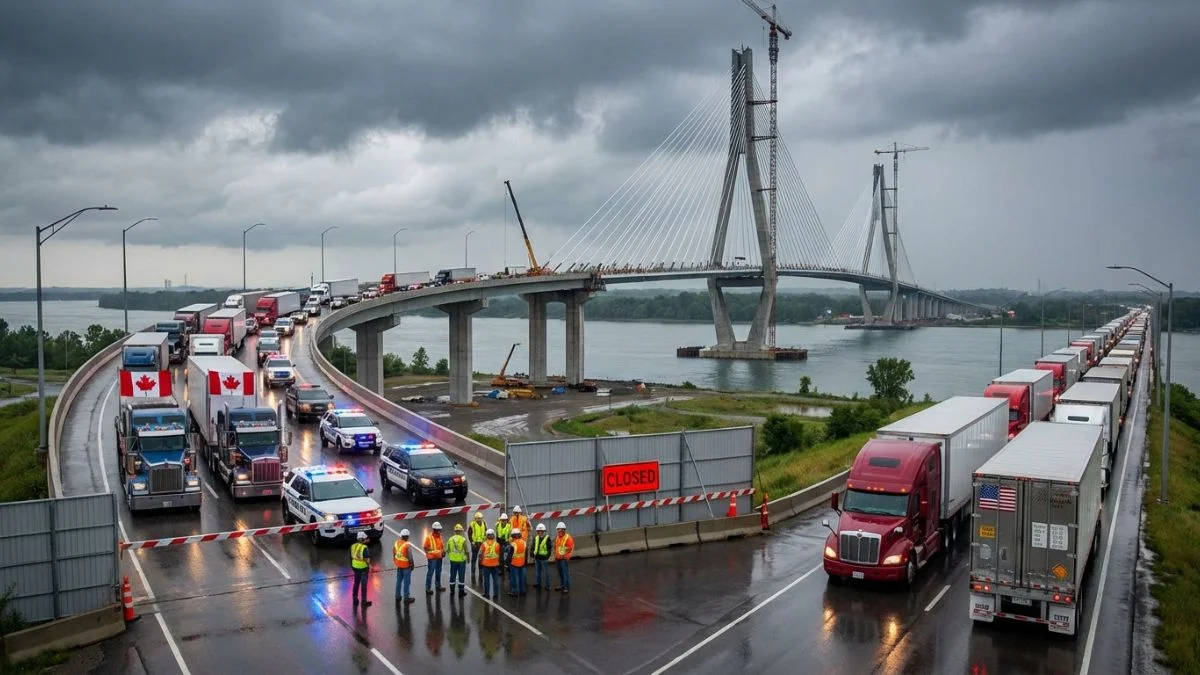
U.S. President Donald Trump has issued a formal threat to prevent the opening of the Gordie Howe International Bridge, a critical multibillion-dollar infrastructure project connecting Windsor, Ontario, and Detroit, Michigan.
In a series of statements made on February 9, 2026, the President demanded that Canada surrender at least 50% ownership of the asset to the United States before the border crossing is allowed to become operational.
Also Read

The bridge, which is currently in its final stages of testing, is designed to be the busiest commercial land crossing in North America. It represents a vital link for the automotive industry and general freight between the two nations.
Presidential Demands and Ownership Disputes
In a social media post, President Trump claimed that the United States has been treated “unfairly” for decades regarding cross-border trade. He argued that despite the bridge being located on the border, the U.S. receives insufficient benefit from the current arrangement.
Key Points of the Dispute:
- Ownership Stakes: Trump asserted that the U.S. should own “at least one half” of the bridge, citing the value of the U.S. market as the primary driver for the bridge’s future revenue.
- Content Requirements: The President criticized the project for allegedly using “virtually no U.S. content,” specifically targeting the use of steel during the early phases of construction.
- Compensation Demands: The White House has indicated that negotiations must begin “immediately” to compensate the U.S. for what Trump described as “everything we have given” to Canada.
Contrary to these claims, official documentation from the Windsor-Detroit Bridge Authority confirms that the $6.4 billion CAD project has been entirely funded by the Canadian federal government. Under a 2012 agreement signed with the state of Michigan, Canada is responsible for the design, construction, and financing of the bridge, with the costs to be recouped through future toll collections.
Impact on Canada-US Trade Relations
The threat to block the bridge comes at a volatile time for North American trade. Diplomatic relations have been strained following Canadian Prime Minister Mark Carney’s recent efforts to diversify trade by engaging with China.
The Gordie Howe International Bridge is intended to alleviate congestion at the aging Ambassador Bridge. According to a study by the University of Windsor, the new crossing is expected to:
- Reduce average crossing times for commercial trucks by approximately 20 minutes.
- Save the trucking industry an estimated $2.3 billion over the next 30 years.
- Provide a direct highway-to-highway connection between Ontario’s Highway 401 and Michigan’s Interstate 75.
Reactions from Michigan and Canadian Officials
The President’s threat has faced immediate pushback from U.S. state leaders and Canadian business groups. Michigan Governor Gretchen Whitmer and other state officials have emphasized that the bridge is a joint asset of Michigan and Canada, noting its importance to the regional economy.
Senator Elissa Slotkin (D-Mich.) described the move as “economic sabotage,” stating that blocking the bridge would lead to higher costs for Michigan businesses and less secure supply chains. “Canada is our friend, not our enemy,” Slotkin noted in a public statement.
The U.S. Customs and Border Protection had recently published a final rule on January 30, 2026, designating the bridge as an official port of entry effective March 2, 2026. This federal designation traditionally signals that the facility is ready for operation, though the President’s executive influence over border crossings remains a significant hurdle.
Current Status and Opening Timeline
Major construction on the six-lane cable-stayed bridge is effectively complete. The project team is currently conducting final inspections, electrical system testing, and staff training for the customs plazas on both sides of the border.
While the official opening was targeted for early 2026, the current political standoff introduces substantial uncertainty for logistics companies and manufacturers who rely on the Windsor-Detroit corridor.
For now, the Windsor-Detroit Bridge Authority continues with its commissioning phase, while federal officials in Ottawa and Washington prepare for potential high-level negotiations regarding the bridge’s operating framework.
Marc Sterling is a knowledgeable writer focused on immigration, citizenship, and visa processes, helping readers navigate complex legal landscapes.
Also he covers all the Latest News around Canada Daily.