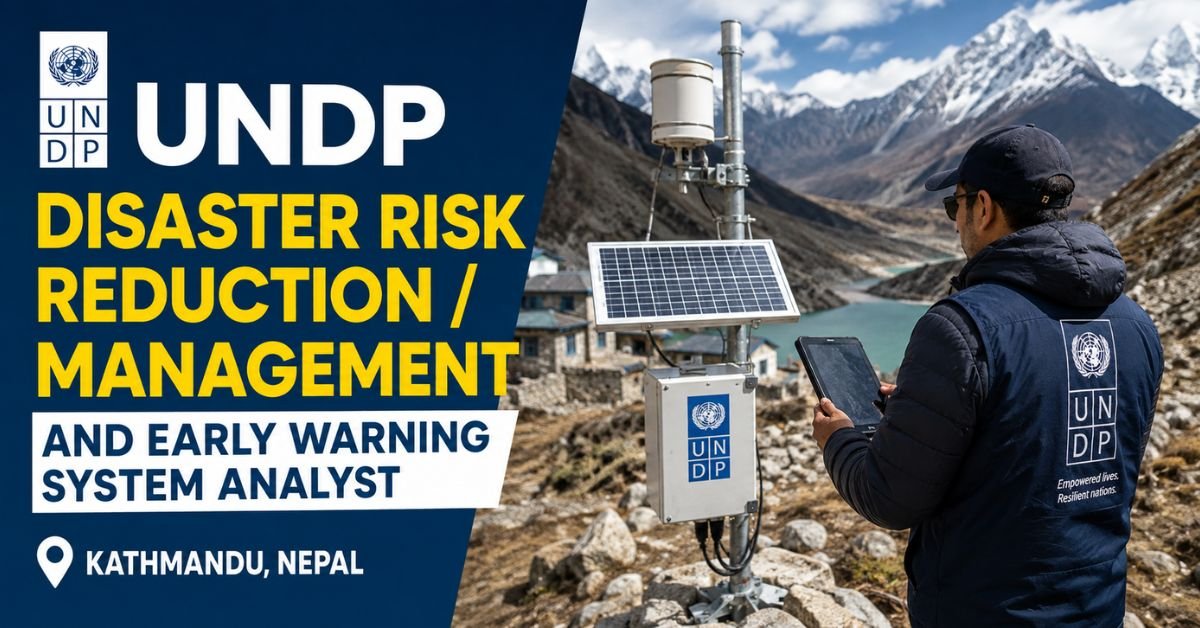
The United Nations Development Programme (UNDP) is recruiting a Disaster Risk Reduction / Management and Early Warning System Analyst for its project in Kathmandu, Nepal.
This is a full-time, one-year National Personnel Service Agreement position at the NPSA-8 level, within the Disaster Risk Reduction and Recovery practice area.
Also Read



The role is closely connected to a project addressing the risks posed by glacial lake outburst floods (GLOFs) in Nepal. The project focuses on four high-risk glacial lakes and combines risk reduction, early warning, environmental measures and institutional capacity development.
It is therefore relevant to professionals who want to work at the intersection of disaster management, climate resilience, early warning systems and community preparedness.
The position may also suit qualified graduates with a relevant master’s degree, since the vacancy states that master’s-level applicants do not need professional work experience. Candidates with a bachelor’s degree can also be considered when they have the required additional experience.
About the Organization
UNDP is the United Nations Development Programme. For this position, UNDP is supporting Nepal’s Department of Hydrology and Meteorology (DHM) under the Ministry of Energy, Water Resources and Irrigation. The project is being implemented through a National Implementation Modality, with a Project Management Unit based in Kathmandu.
The work is focused on strengthening Nepal’s ability to anticipate and respond to GLOFs and floods while improving technical and institutional capacity.
Position Overview
The Analyst will be part of the Project Management Unit and report directly to the Project Coordination Specialist. The PMU operates under the overall guidance of the National Project Director assigned by the Ministry of Energy, Water Resources and Irrigation.
At its core, the position combines technical oversight, disaster risk management, early warning systems, data management and community capacity building. The successful candidate will not simply work on the technical side of warning systems. The role also involves checking that systems are inclusive, properly implemented, connected with national structures and useful to communities facing disaster risks.
Key Responsibilities
A major part of the work involves overseeing the development and implementation of multi-hazard early warning systems. The Analyst will review system designs, operating procedures and protocols, monitor the quality of implementation and help ensure that warnings can reach vulnerable communities.
The position also involves working with hydrological and meteorological specialists to strengthen the capacity of DHM. This includes supporting the production and dissemination of warnings, as well as community-based risk assessments, response planning and disaster preparedness activities.
During installation and commissioning, the Analyst will monitor contractors and help verify that early warning components are properly delivered and documented. The role includes certifying relevant deliverables and checking records required for payments, handovers and audits.
Training and knowledge sharing are another important part of the position. The Analyst will work with government personnel and communities, support drills and simulations, develop awareness materials and document useful practices and lessons from the project.
The role also carries significant reporting and monitoring responsibilities. This includes maintaining equipment and project records, contributing to workplans and budgets, tracking implementation progress, preparing technical updates and providing inputs to donor reports and evaluations.
An additional focus is gender and social inclusion. The Analyst will help make risk assessments, preparedness measures and warning systems responsive to the needs of different groups, including women, young people, older people, persons with disabilities and marginalized communities. The role also involves supporting participation by community organizations and improving the accessibility of warning information.
Data management is another substantial component. The position will support the development and operation of a Disaster Information Management System covering early warning, hydrometeorological, risk assessment and community disaster-management data. This includes establishing data standards and supporting integration with relevant national information systems, dashboards and decision-support tools.
Eligibility & Qualifications
Applicants should have an advanced university degree, such as a master’s degree or equivalent, in Disaster Risk Management, Engineering, Environmental Sciences or another relevant discipline. Candidates with a bachelor’s degree in these fields may also be considered if they have at least two additional years of relevant experience.
For master’s-level applicants, the vacancy states that professional work experience is not required. Bachelor’s-level applicants must have at least two years of experience in disaster risk management and early warning systems.
The employer lists experience in disaster risk reduction, early warning and hazard risk management among the desired qualifications. Experience developing operational protocols and training, as well as knowledge of gender and social inclusion in early warning and anticipatory action, is also valued.
Other desirable experience includes work involving WMO frameworks and Sendai DRR targets, the Hindu Kush Himalayan region, GLOF and monsoon flood risk reduction, and donor-funded climate adaptation or disaster risk reduction projects. Familiarity with environmental and climate change issues in Nepal is also listed.
Fluency in both English and Nepali is required. Knowledge of another local language is considered an asset.
Skills Needed
The vacancy places importance on geospatial analysis, risk management, partnership building and strategic sourcing. Candidates should also be comfortable working across disaster risk reduction, climate adaptation, governance and gender-related areas.
The listed core competencies include planning and delivering quality work, practical problem-solving, continuous learning, adaptability, determination, collaboration and respect for diversity. These qualities matter because the position combines technical responsibilities with coordination among government institutions, communities, contractors and other project stakeholders.
Salary & Benefits
The employer has not publicly disclosed the salary for this position.
The vacancy is for a one-year National Personnel Service Agreement and is classified at NPSA-8.
How to Apply
The position is based in Kathmandu, Nepal, and applications should be submitted through the official UNDP recruitment system. The listed application deadline is August 14, 2026, at 08:59 AM.
Applicants should check the vacancy’s eligibility requirements carefully before submitting an application. The posting also explains a tiered application approach for certain UNDP, UNCDF and UNV personnel, so candidates should review the stated eligibility category applicable to them.
Candidates should apply only through the official UNDP recruitment website. UNDP also states that it does not charge applicants a fee at any stage of recruitment.
Tips Before Applying
Start by checking whether your degree matches one of the fields specified in the vacancy. If you are applying with a bachelor’s degree, make sure your experience clearly demonstrates the required two years in disaster risk management and early warning systems.
Your CV should make relevant experience easy to identify. Give particular attention to work involving DRR, EWS, hazard management, training, data systems, geospatial analysis, community preparedness or climate-related disaster projects where applicable.
Review the desired qualifications as well. Experience with GLOF risk, the Hindu Kush Himalayan region, WMO frameworks, Sendai DRR targets or donor-funded projects may be particularly relevant if you have it.
Before submitting, check your language qualifications and ensure that your application accurately reflects your English and Nepali proficiency. Finally, review the complete vacancy carefully and submit through the official recruitment channel before the stated deadline.
Conclusion
This UNDP position offers a focused opportunity for professionals and suitably qualified graduates interested in disaster risk reduction, early warning systems and climate resilience. The work combines technical review, data management, institutional strengthening and community engagement within a project addressing significant GLOF risks in Nepal.
Candidates who meet the education, experience and language requirements should review the full vacancy carefully and assess how closely their background matches the role before applying.