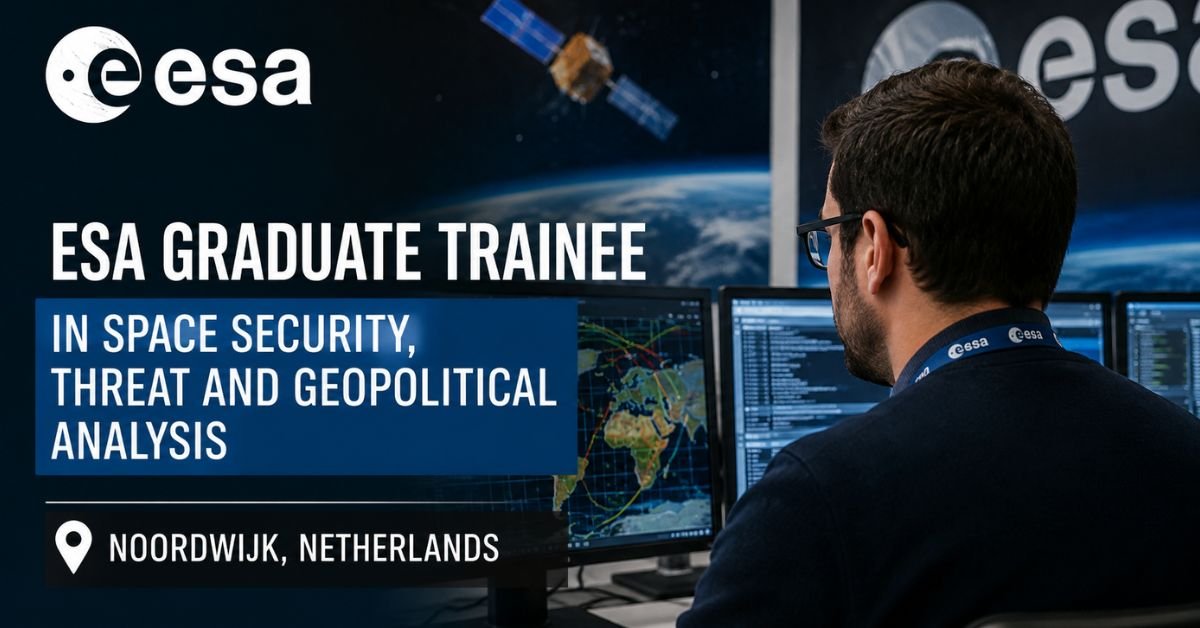
The European Space Agency (ESA) is recruiting a Graduate Trainee in Space Security, Threat and Geopolitical Analysis at ESTEC in Noordwijk, Netherlands. The traineeship is aimed at candidates who have just completed, or are in the final year of, a relevant master’s degree and want to work at the intersection of space systems, security analysis and European policy.
The position sits within ESA’s Directorate of Resilience, Navigation and Connectivity and focuses on understanding threats to satellite navigation and secure connectivity, as well as their wider strategic and geopolitical implications. The application deadline is 30 September 2026 at 23:59 CET/CEST.
Also Read



ESA Graduate Trainee Opportunity: Key Details
| Detail | Information |
|---|---|
| Organisation | European Space Agency (ESA) |
| Position | Graduate Trainee in Space Security, Threat and Geopolitical Analysis |
| Job Requisition ID | 20876 |
| Appointment type | ESA Graduate Trainee |
| Directorate | Resilience, Navigation and Connectivity |
| Office | Space Resilience Office at ESTEC |
| Location | Noordwijk, Netherlands |
| Grade Band | F1 – F1 |
| Date posted | 1 February 2026 |
| Closing date | 30 September 2026, 23:59 CET/CEST |
| Publication | External Only |
| Working languages | English and French |
What would you work on at ESA?
The traineeship is built around security and threat analysis for European satellite navigation and secure connectivity programmes. The work can combine technical assessment with policy and geopolitical analysis, making it broader than a purely engineering or purely international-relations position.
Under the guidance of the Head of the Space Resilience Office, the trainee will help examine how threats could affect space systems and what those threats mean for European security and resilience.
Typical areas of work include:
- Monitoring technical, security, policy and geopolitical developments affecting European space programmes.
- Analysing threats such as cyber attacks, radio-frequency interference, jamming and spoofing.
- Examining vulnerabilities across space, ground and user segments.
- Supporting security, risk and resilience assessments and identifying possible mitigation measures.
- Following regulatory, policy and strategic developments related to European space security.
- Assessing security and geopolitical risks connected with international partnerships, critical technologies and supply chains.
- Preparing concise briefings and structured assessments for management, governing bodies and stakeholder meetings.
- Maintaining open-source information on threats, incidents, technologies and geopolitical developments.
- Supporting cooperation with ESA teams, European institutions, Member States, industry, academia and international partners.
The traineeship is therefore particularly multidisciplinary. ESA says the role is suitable for candidates coming from either technical or policy backgrounds who want to develop a broader understanding of space security.
Who is eligible for this ESA graduate traineeship?
Applicants should have just completed, or be in the final year of, a master’s degree in a relevant discipline. The source specifically identifies fields including:
- Aerospace engineering
- Telecommunications engineering
- Systems engineering
- Cybersecurity
- Computer science
- Security engineering
- Security studies
- International relations
- Political science
- Geopolitics
- Another discipline relevant to the activities described
The role is not limited to one academic profile. Technical candidates are encouraged to demonstrate an interest in security policy, international relations or geopolitics, while policy and international-affairs candidates should show an interest in understanding space systems and technical security threats.
Relevant experience from university projects, internships, research, extracurricular activities or international teamwork can be an asset. Familiarity with open-source research, risk or threat analysis, cybersecurity, satellite communications, navigation systems, or European security and defence policy is also considered an asset.
Nationality requirements are important
This ESA position has a specific nationality requirement. Applications can only be considered from nationals of ESA Member States listed in the vacancy, as well as nationals of certain Associate Member, Cooperating State and European Cooperating State countries.
The eligible nationalities listed by ESA are:
Member States: Austria, Belgium, Czechia, Denmark, Estonia, Finland, France, Germany, Greece, Hungary, Ireland, Italy, Luxembourg, the Netherlands, Norway, Poland, Portugal, Romania, Slovenia, Spain, Sweden, Switzerland and the United Kingdom.
Additional eligible states listed: Cyprus, Latvia and Lithuania and Slovakia as Associate Member States; Canada as a Cooperating State; and Bulgaria, Croatia and Malta as European Cooperating States.
This requirement should be checked carefully before applying, particularly for candidates studying or working outside these countries.
What skills is ESA looking for?
Beyond the degree requirement, ESA is looking for candidates who can work comfortably across technical, analytical and institutional subjects.
Strong analytical, interpersonal and communication skills are expected. Candidates should be able to synthesise complicated technical or policy information and explain it clearly to different audiences. The ability to work independently as well as within a multicultural team is also important.
ESA lists the following behavioural competencies:
- Result Orientation
- Operational Efficiency
- Fostering Cooperation
- Relationship Management
- Continuous Improvement
- Forward Thinking
A genuine interest in space security, resilience, geopolitics and European space affairs is expected.
The role may also be subject to security clearance and export control requirements because of the nature of its activities.
What should applicants know about the selection process?
ESA states that applicants may be asked to complete selection tests during recruitment. Successful candidates will also need to undergo basic screening before appointment through an external background-screening service, in accordance with ESA security procedures.
Applicants must also be eligible to access information, technology and hardware subject to European or US export-control and sanctions regulations.
The source does not provide a salary figure or specific employment benefits, so applicants should refer to ESA’s official careers information for any working-condition details relevant to the appointment.
Language requirements
The working languages of ESA are English and French, and a good knowledge of one of these languages is required.
Knowledge of another language of an ESA Member State is considered an asset.
Why this traineeship is distinctive
This position is particularly focused on the point where space technology, security and geopolitics meet. A trainee may be expected to understand technical threats such as jamming or cyber risks while also considering policy developments, international partnerships, supply-chain dependencies and the broader European security environment.
For technical graduates, that creates an opportunity to develop policy and strategic-analysis skills. For candidates from international relations, political science or security studies, the position offers a route into understanding the technical side of space-system resilience.
The experience is also designed to develop concise strategic communication, multidisciplinary analysis and cooperation with technical and institutional stakeholders.
How to apply for the ESA Graduate Trainee position
The application deadline is 30 September 2026 at 23:59 CET/CEST.
Before submitting an application, candidates should make sure they meet the stated master’s-degree, nationality and language requirements and consider whether their academic projects, internships, research or other experience demonstrates a genuine interest in the subject areas covered by the traineeship.
Applicants should also be prepared for the possibility of selection tests and the basic screening process described by ESA.