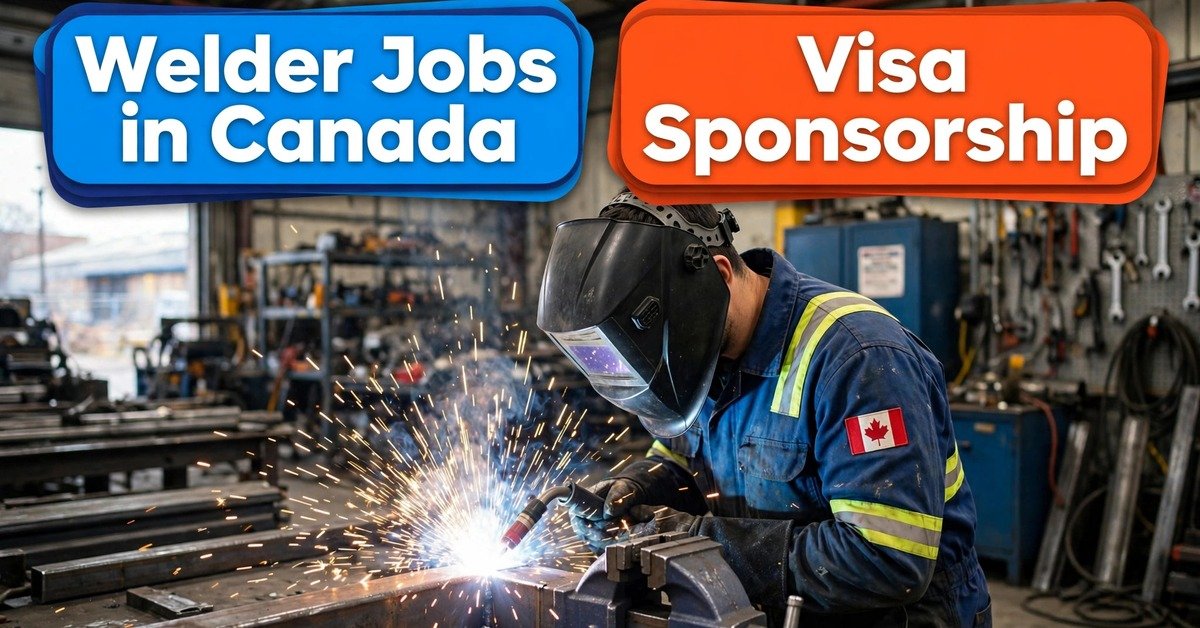
Welders join metal parts to build and repair structures, machines, pipes, and vehicles. In Canada, welders work in construction, manufacturing, and repair shops. Many Canadian employers seek trained welders from other countries, as demand for this trade stays strong.
Visa sponsorship in Canada does not mean a free visa or a guaranteed job. It usually means a Canadian employer offers you a job and supports your work permit application. The employer must first show that no Canadian worker is available for the role. Here is how it works.
Also Read



What Welders Do in Canada
A welder reads drawings, cuts and shapes metal, and joins pieces using heat and pressure. Some welders build steel frames for buildings and bridges. Others work on pipelines, pressure vessels, ships, mining equipment, or factory machines.
The most common methods in Canada are MIG, TIG, stick welding, and flux core welding. MIG is fast and widely used in factories and fabrication shops. TIG is slower and more precise, and it suits thin metal and neat joints. Stick welding works well outdoors and on construction sites. A welder who knows two or more methods has more job options than one who knows only one. Most welders work full time, usually thirty-five to forty hours per week.
Why Canadian Employers Hire Foreign Welders
Canada has a large construction and manufacturing sector, and welding is a core trade in both. New buildings, roads, bridges, factories, and energy projects all need welders. At the same time, many experienced Canadian welders are reaching retirement age, and fewer young workers are entering the trade. This gap creates real openings for trained welders from other countries.
Employers also need welders with specific skills. A pressure vessel company needs a pressure welder, and a shipyard needs welders for large steel plates. When a local worker with the right skill is not available, the employer can look abroad. Sponsorship suits both sides: the employer needs your skill, and you need a legal way to work in Canada.
How Visa Sponsorship Works for Welders
Most sponsored welder jobs in Canada use the Temporary Foreign Worker Program. First, the employer applies for a Labour Market Impact Assessment, known as an LMIA, from Employment and Social Development Canada. The LMIA confirms a real need for a foreign worker and that no Canadian citizen or permanent resident is available for the job. If the LMIA is positive, the employer gives you a copy of the job offer and the LMIA details. You then apply for an employer-specific work permit through Immigration, Refugees and Citizenship Canada, known as IRCC, using your passport, the job offer, and the LMIA number. A border officer issues the actual work permit when you arrive in Canada.
The employer pays for the LMIA. You should never pay an employer or an agent for an LMIA. You may need to pay your own government fees, such as the work permit fee of one hundred and fifty-five dollars and biometrics of eighty-five dollars, if they apply to you.
Work Permit and Permanent Residence Routes
A work permit lets you live and work in Canada for a set period. Many welders later apply for permanent residence. There is no single route for everyone. The right path depends on your experience, your language level, and your job offer.
- Federal Skilled Trades Program: Part of the Express Entry system. Welders usually need at least two years of full-time work experience in the trade within the last five years, plus either a full-time job offer of at least one year or a Canadian certificate of qualification in welding. Basic English or French language results are also required.
- Provincial Nominee Program: A province can nominate a skilled welder who has a job offer or work experience in that province. Each province sets its own rules, and some run streams for skilled trades.
No route guarantees permanent residence. Each program has points, draws, and limits. A positive LMIA job offer can strengthen an Express Entry profile, but it does not remove the other requirements.
How Much Welders Earn in Canada
Pay depends on experience, location, certification, and the industry. Job Bank Canada reports a national median wage of thirty dollars per hour for welders and related machine operators, with a typical range from twenty-two dollars to forty-seven dollars per hour. Alberta reports a higher median of around thirty-two dollars per hour.
| Role or Level | Typical Hourly Pay | Notes |
|---|---|---|
| Entry-level welder | Twenty to twenty-five dollars | Apprentice or newly trained worker |
| Experienced welder | Around thirty dollars | National median wage per Job Bank |
| Certified journeyperson | Thirty to forty dollars | Red Seal or provincial certificate |
| Specialist or pressure welder | Forty-five dollars and above | Pressure tickets, remote or shutdown work |
These figures are guides, not promises — always confirm the wage in your written job offer.
Red Seal Certification and Other Certificates
The Red Seal is the national standard for welders in Canada. With a Red Seal, you can work as a welder in any province or territory without taking another exam. The Red Seal exam for welders has one hundred and twenty-five questions and a pass mark of seventy percent. Most welders qualify through an apprenticeship of about five thousand four hundred hours of work and classroom training.
Whether you must hold a certificate depends on where you work. In Alberta, welding is a compulsory trade, which means you need a journeyperson certificate or a recognised trade certificate for restricted work. In Ontario, welding is a non-compulsory trade, so you can work without a certificate, although holding one still helps you get hired. Experienced welders from other countries can sometimes challenge the exam by proving enough work hours and trade experience. The Canadian Welding Bureau, known as CWB, also certifies welders, and many employers ask for CWB certification.
How to Apply for Welder Jobs in Canada
Apply step by step, and avoid paid agents or vague job ads. Most employers ask for two or more years of hands-on experience, training in MIG, TIG, stick, or flux core welding, and the ability to read blueprints.
- Check your experience and certificates. Gather proof of your training and your past jobs before you apply.
- Search trusted job sites such as Job Bank Canada and Indeed Canada for welder jobs.
- Read each job ad fully. Check whether it mentions a work permit, an LMIA, or support for foreign workers.
- Prepare a short Canadian-style resume.
- Apply directly to the employer through the job site or the company careers page.
- If an employer offers you a job, ask for the written offer and the LMIA details. Do not pay anyone for the job offer or the LMIA.
If an employer asks you to pay for a job, a visa, or an LMIA, walk away. Real Canadian employers do not charge workers for hiring. Report suspected fraud to IRCC and to the Canadian Anti-Fraud Centre.
Frequently Asked Questions
Do I need a university degree to work as a welder in Canada?
No. Welding is a skilled trade. Employers look for trade training, hands-on experience, and certificates.
Is the Red Seal certificate required for foreign welders?
It depends on the province. Alberta requires certification for restricted welding work, while Ontario treats welding as a non-compulsory trade.
Welder jobs in Canada with visa sponsorship are real, but they reward preparation. Build your skills, gather proof of your experience, learn which certificates your province needs, and apply only through trusted job sites and real employers. A careful approach protects your money and gives you the best chance of a stable welding career in Canada.