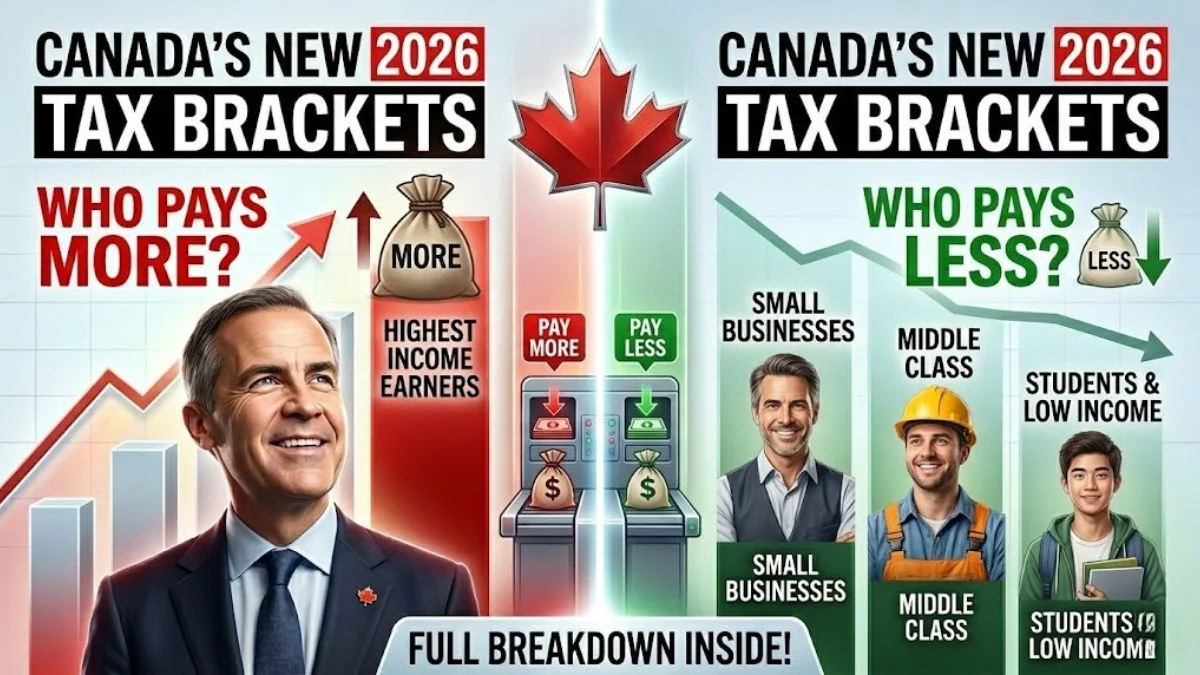
The Canada Revenue Agency (CRA) has officially implemented the new federal income tax brackets and benefit adjustments for the 2026 tax year.
These changes are part of an annual process where tax thresholds are indexed to inflation to prevent “bracket creep,” ensuring that taxpayers do not pay higher taxes simply because their wages rose to keep up with the cost of living.
Also Read



For 2026, the Canada Revenue Agency applied an indexation factor of 2.0%, reflecting the stabilization of the Consumer Price Index. This adjustment, combined with a significant reduction in the lowest tax rate, will alter the take-home pay for millions of Canadians.
Federal Income Tax Brackets for 2026
The most notable change this year is the full implementation of the federal rate reduction for the lowest income tier. While 2025 saw a transitionary “blended” rate of 14.5%, the 2026 tax year marks the first full year where the bottom bracket is taxed at 14%.
The 2026 federal tax tiers are as follows:
- 14% on the first $58,523 of taxable income.
- 20.5% on the portion of taxable income between $58,523 and $117,045.
- 26% on the portion of taxable income between $117,045 and $181,440.
- 29% on the portion of taxable income between $181,440 and $258,482.
- 33% on any taxable income exceeding $258,482.
These thresholds represent an increase from the previous year, meaning Canadians can earn slightly more in each category before moving into a higher marginal tax rate.
The Basic Personal Amount (BPA) and High-Income Phase-Out
The Basic Personal Amount (BPA) is a non-refundable tax credit that allows individuals to earn a certain amount of income before paying any federal income tax. For 2026, the maximum BPA has increased to $16,452.
However, this credit is subject to a phase-out for high earners. Individuals with a net income of $181,440 or less receive the full credit. For those earning more, the amount gradually reduces until it reaches a “floor” of $14,829 for individuals whose income exceeds $258,482. This ensures that the largest tax relief is targeted at low-to-middle-income households.
Payroll Deductions: CPP and EI Contributions
While income tax rates have softened for the lowest bracket, payroll taxes continue to rise due to higher earning ceilings.
Canada Pension Plan (CPP)
The Canada Pension Plan contribution rate remains steady at 5.95% for both employees and employers. However, the Year’s Maximum Pensionable Earnings (YMPE) has risen to $74,600. Furthermore, the “CPP2” second tier now applies to earnings between $74,600 and $85,000 at a rate of 4%. This means workers earning over $85,000 will see a higher total deduction compared to last year.
Employment Insurance (EI)
For 2026, the EI premium rate for employees is 1.63%, with a maximum annual insurable earnings ceiling of $68,900. This results in a maximum annual employee contribution of $1,123.07. Employers continue to pay 1.4 times the employee rate, reaching a maximum of $1,572.30 per employee.
Who Pays More and Who Pays Less?
Who Pays Less
Low-income earners and middle-class families are the primary beneficiaries of the 2026 tax structure. The drop in the initial tax rate from 15% (prior to 2025) to a clean 14% provides direct relief. When combined with the 2.0% increase in bracket thresholds, a two-income family could see hundreds of dollars in annual savings. Additionally, parents will see a modest 2.0% boost in Canada Child Benefit (CCB) payments starting in July 2026.
Who Pays More
High-income earners may see a net increase in their total government deductions despite the indexed brackets. The combination of the BPA phase-out and the expanded CPP2 contributions means those earning above $181,440 will not feel the same relief as lower-income tiers. Specifically, those in the $85,000+ range will contribute more to national pension funds than in any previous year.
Key Filing Deadlines for 2026
As the tax season progresses, Canadians should keep the following dates in mind:
- April 30, 2026: The standard deadline for most individuals to file their 2025 income tax returns and pay any balances owing.
- June 15, 2026: The deadline for self-employed individuals and their spouses or partners to file, though any taxes owed must still be paid by April 30 to avoid interest.
- July 1, 2026: The date when newly calculated benefit amounts, such as the GST credit and CCB, take effect.
Frequently Asked Questions
What is the lowest federal tax rate in Canada for 2026?
The lowest federal income tax rate for 2026 is 14%, applying to the first $58,523 of taxable income.
What is the maximum Basic Personal Amount for the 2026 tax year?
For 2026, the maximum Basic Personal Amount is $16,452, which is the amount you can earn before paying federal tax.
Has the TFSA contribution limit changed for 2026?
No, the Tax-Free Savings Account (TFSA) annual contribution limit remains at $7,000 for 2026.

Ben Lee is a content writer specializing in government schemes and public benefit programs, delivering clear and up-to-date information to help readers understand eligibility, payments, and policy changes.