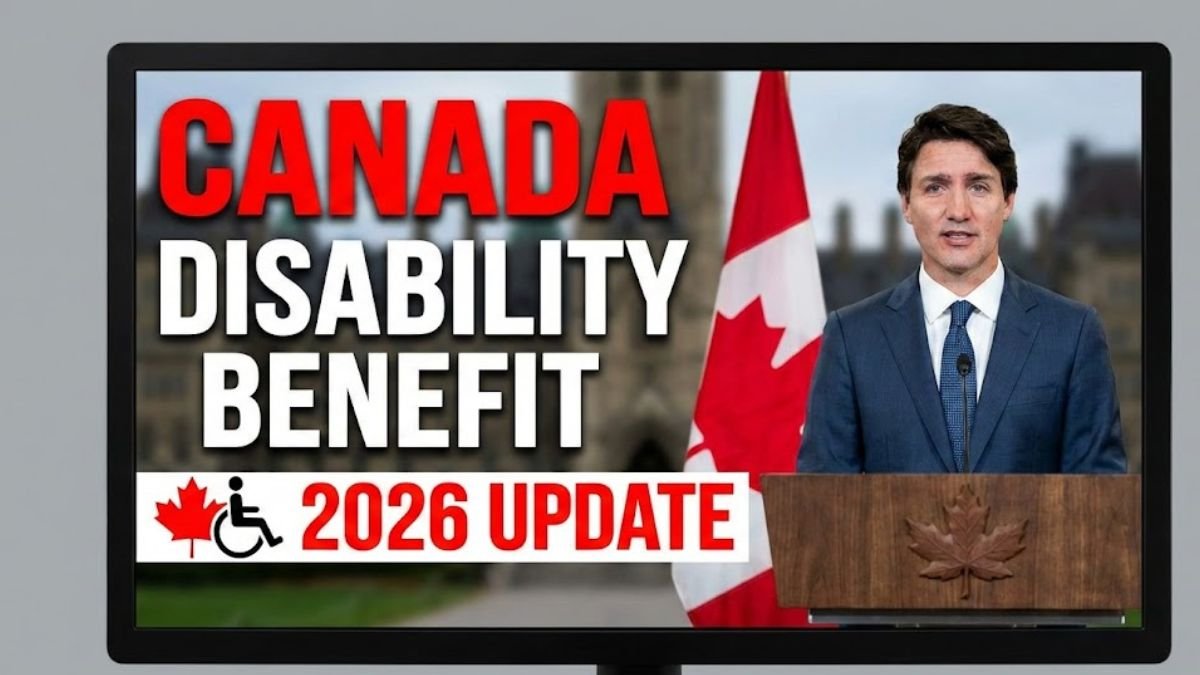
The rollout of the Canada Disability Benefit (CDB) marks a significant shift in the federal government’s approach to supporting working-age Canadians living with disabilities.
As the program moves into its first full calendar year in 2026, thousands of eligible citizens are preparing to receive their monthly payments aimed at reducing poverty and providing essential financial stability.
Also Read



This comprehensive guide details the official payment schedule for 2026, specific eligibility requirements, and the latest updates regarding supplemental payments and application procedures.
Understanding the New Federal Income Support
The Canada Disability Benefit was established through the Canada Disability Benefit Act to provide a direct, tax-free monthly payment to low-income, working-age persons with disabilities.
Unlike the Canada Pension Plan Disability (CPPD) benefit, which is a contributory program based on previous earnings, the CDB is an income-tested benefit designed to supplement existing provincial and territorial supports.
The primary objective of this benefit is to bridge the gap between the high cost of living with a disability and the often-insufficient income provided by traditional welfare or provincial disability programs.
For the 2026 benefit year, the program continues to target individuals between the ages of 18 and 64, ensuring that those in their working years have a foundational level of financial security.
Official Canada Disability Benefit 2026 Payment Dates
To help beneficiaries manage their household budgets, the Government of Canada has released the scheduled dates for 2026. Payments are typically issued on the third Thursday of every month. For those who have signed up for direct deposit, the funds should appear in their bank accounts on these specific dates. If you receive your benefit via cheque, you should allow additional time for mail delivery through Canada Post.
| Month | Payment Date |
| January 2026 | January 15, 2026 |
| February 2026 | February 19, 2026 |
| March 2026 | March 19, 2026 |
| April 2026 | April 16, 2026 |
| May 2026 | May 21, 2026 |
| June 2026 | June 18, 2026 |
| July 2026 | July 20, 2026 |
| August 2026 | August 20, 2026 |
| September 2026 | September 17, 2026 |
| October 2026 | October 15, 2026 |
| November 2026 | November 19, 2026 |
| December 2026 | December 17, 2026 |
It is important to note that if your payment does not arrive on the scheduled date, Service Canada recommends waiting at least five business days before contacting their support centers to inquire about the delay.
Core Eligibility Requirements for 2026
To qualify for the Canada Disability Benefit in 2026, an applicant must meet several strict criteria established by the Department of Employment and Social Development.
The program is not universal; rather, it is highly targeted toward those with the greatest demonstrated need.
1. Age and Residency
Applicants must be at least 18 years old but under the age of 65. Once a beneficiary turns 65, they typically transition to senior-focused benefits such as Old Age Security (OAS) and the Guaranteed Income Supplement (GIS).
Additionally, you must be a resident of Canada for income tax purposes, which includes being a Canadian citizen, a permanent resident, or a protected person.
2. Disability Tax Credit (DTC) Certification
The most critical non-financial requirement is having a valid and approved Disability Tax Credit (DTC) certificate from the Canada Revenue Agency (CRA). The CDB program uses the DTC as the gateway for eligibility.
If you have not yet applied for the DTC, or if your previous certification has expired, you must complete Form T2201 and have it certified by a medical practitioner before you can be considered for the Canada Disability Benefit.
3. Income Tax Filing
Eligibility is determined based on the previous year’s tax data. For the first half of 2026 (January to June), your eligibility is based on your 2024 tax return. For the second half (July to December), it will transition to the 2025 tax return data.
Both you and your spouse or common-law partner (if applicable) must have filed your taxes to remain eligible, as the benefit is calculated using your “adjusted family net income.”
Maximum Benefit Amounts and Income Thresholds
The maximum amount a single individual can receive through the Canada Disability Benefit is $2,400 per year, which translates to $200 per month. This amount is indexed to inflation to ensure that the value of the support does not erode as the cost of living increases.
Income Testing and Reductions
The CDB is designed to decrease as your income rises. The government applies a “reduction rate” to the benefit based on how much your adjusted family net income exceeds specific thresholds.
- Single Individuals: You will receive the full $200 monthly benefit if your adjusted family net income is $23,000 or less. For every dollar earned above this $23,000 mark, the benefit is reduced by 20 cents. Generally, if a single person’s income exceeds $35,000 (without exemptions), the benefit amount becomes zero.
- Couples (One Eligible): If only one person in a couple is eligible for the benefit, the maximum amount is provided if the combined family income is $32,500 or less.
- Couples (Both Eligible): If both partners qualify for the CDB, the threshold remains $32,500 for the full benefit, with a 10% reduction rate applied to each individual’s benefit for every dollar above that limit.
Working Income Exemption
To encourage employment, the government has implemented a “Working Income Exemption.” This allows a certain amount of employment or self-employment income to be excluded from the benefit calculation.
In 2026, single individuals can exempt up to $10,000 of working income, while couples can exempt up to $14,000. This ensures that those who are able to work part-time are not unfairly penalized by a sudden loss of disability support.
How to Apply for the Canada Disability Benefit
If you are already approved for the Disability Tax Credit, you may have received a letter from Service Canada containing a unique 6-digit application code. This code allows for an expedited application process. However, if you did not receive a code but believe you qualify, you can still apply through several channels.
Online Application (Recommended)
The fastest way to apply is through the Service Canada online portal. You will need your Social Insurance Number (SIN), your mailing address, and your 2024 Notice of Assessment from the CRA.
Applying online allows you to track the status of your application and ensures that your direct deposit information is securely recorded.
Phone and In-Person Options
For those who prefer not to use online services, you can call the dedicated Canada Disability Benefit hotline at 1-833-486-3007. Alternatively, you can visit any Service Canada Centre in person to receive assistance with the forms.
Paper Applications
A printed application form is available for those who wish to apply by mail. Completed forms should be sent to the CDB Processing Centre in Boucherville, Quebec. Note that paper applications typically take longer to process than digital submissions.
Latest Updates: The $150 Supplemental Payment
A recent announcement from the federal government regarding Budget 2025 has introduced a one-time supplemental payment of $150. This payment is intended to help offset the administrative and medical costs associated with applying for or re-certifying the Disability Tax Credit.
Recipients who qualify for the Canada Disability Benefit can expect to see this supplemental payment before the end of the 2026-27 fiscal year. This measure recognizes that many people with disabilities face financial barriers when seeking the medical documentation required for federal tax credits.
Canada Disability Benefit vs. CPP Disability
It is essential to distinguish the new Canada Disability Benefit from CPP Disability benefits. Many Canadians receive both, but they serve different purposes.
- CPP Disability: Based on your contributions to the Canada Pension Plan while working. The maximum monthly amount for 2026 is approximately $1,741.20 for those with a “severe and prolonged” disability.
- Canada Disability Benefit: A non-contributory, income-tested supplement. Its maximum is $200 per month.
The CDB is designed as a “top-up.” Crucially, the federal government has worked with most provinces and territories to ensure that receiving the CDB does not result in a clawback of provincial disability supports. This means that for most residents, the CDB is truly additional income.
Final Considerations for Beneficiaries
As 2026 progresses, beneficiaries are encouraged to keep their personal information up to date with both Service Canada and the CRA. Any change in marital status, residency, or income can affect your monthly payment amount. Furthermore, the 24-month retroactive payment rule remains in effect; if you are approved for the benefit in 2026 but were eligible as early as July 2025, you may be entitled to a lump-sum back payment.
By staying informed about the official payment dates and maintaining DTC certification, Canadians living with disabilities can better utilize this new federal support to improve their quality of life and financial independence.
Frequently Asked Questions
What is the maximum amount of the Canada Disability Benefit in 2026?
The maximum amount is $200 per month, totaling $2,400 annually, and is indexed to inflation.
When are the first payments for the Canada Disability Benefit in 2026?
The first payment of the year is scheduled for January 15, 2026, with subsequent payments on the third Thursday of each month.
Do I need to apply for the Canada Disability Benefit if I already receive CPP Disability?
Yes, you must apply for the CDB separately, as it is a different program with its own income-based eligibility criteria.

Ben Lee is a content writer specializing in government schemes and public benefit programs, delivering clear and up-to-date information to help readers understand eligibility, payments, and policy changes.