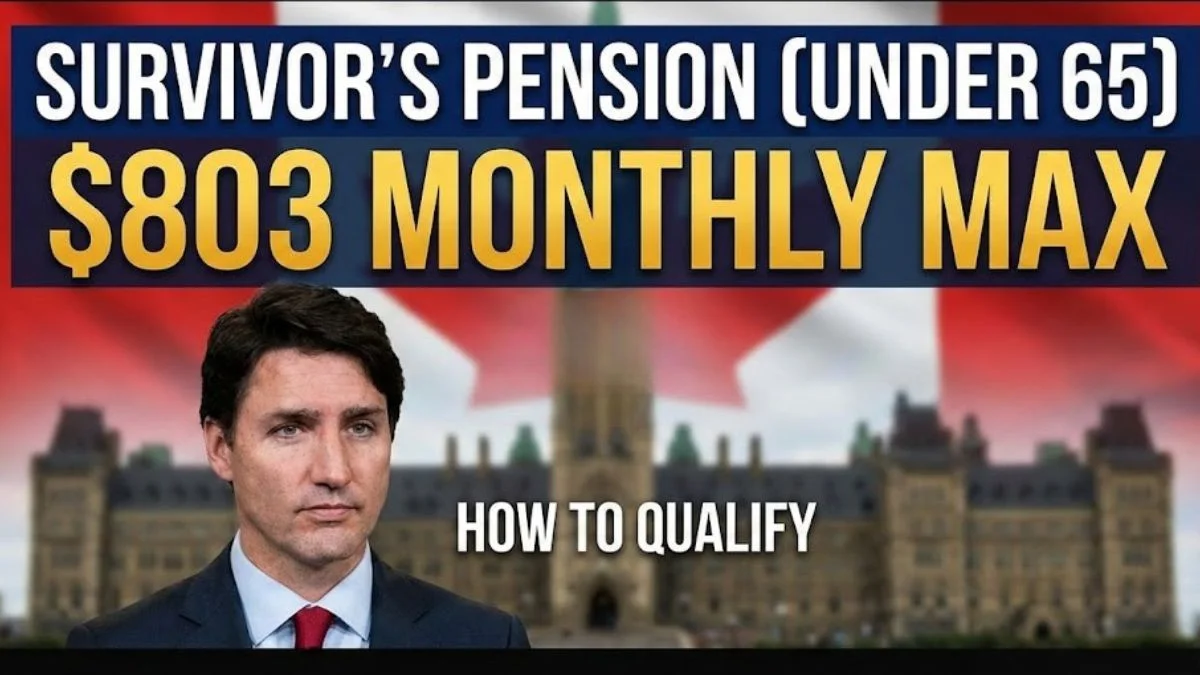
As of January 2026, the Canada Pension Plan (CPP) has updated its benefit rates, setting the new maximum monthly payment for survivors under the age of 65 at $803.54.
This adjustment reflects the annual cost-of-living increases and the ongoing enhancements to the national pension framework. For many surviving spouses and common-law partners, understanding the specific criteria to reach this maximum threshold is essential for long-term financial planning.
Also Read



Eligibility Requirements for the CPP Survivor’s Pension
The survivor’s pension is a monthly payment made to the legal spouse or common-law partner of a deceased contributor. To qualify for these benefits under the age of 65, several conditions must be met regarding both the survivor and the deceased individual’s history.
- Relationship Status: You must have been legally married to the contributor or have lived in a common-law relationship for at least one continuous year prior to their death.
- Contributor Requirements: The deceased person must have made sufficient contributions to the Canada Pension Plan for a minimum qualifying period. This usually means they contributed for either one-third of the years in their contributory period (with a minimum of 3 years) or at least 10 years.
- Age-Based Adjustments: While the maximum is available to those under 65, the specific amount can be affected by the survivor’s age at the time of the contributor’s death.
- Over age 45: Survivors receive the full survivor’s pension.
- Between age 35 and 45: The pension amount is reduced by 1/120 for every month the survivor is under age 45.
- Under age 35: Generally, survivors do not receive the pension until they turn 65, unless they have a disability or are raising dependent children.
Breakdown of the $803 Monthly Maximum in 2026
The maximum monthly payment of $803.54 for 2026 is comprised of two distinct parts: a flat-rate portion and an earnings-related portion.
- Flat-Rate Portion: This is a fixed amount paid to all eligible survivors regardless of the deceased’s earnings. For 2026, the flat-rate portion is set at $238.17.
- Earnings-Related Portion: This constitutes 37.5% of the deceased contributor’s retirement pension. For 2026, the maximum for this portion is $565.37.
When combined, these figures reach the total monthly maximum. It is important to note that most beneficiaries receive an average amount—approximately $533.55—based on the actual lifetime earnings and contributions of their deceased partner.
Contribution Requirements of the Deceased
To reach the maximum payout, the deceased contributor must have earned at or above the Year’s Maximum Pensionable Earnings (YMPE) for the majority of their working life. In 2026, the YMPE is established at $74,600. Those who earned significantly less than this threshold will result in a lower earnings-related portion for their surviving partner.
How to Apply and Required Documentation
Benefits do not begin automatically upon the death of a contributor; the survivor must submit a formal application through Service Canada. Applications can be completed online via the My Service Canada Account (MSCA) or by mailing a paper application.
To ensure a smooth process, applicants should have the following information ready:
- Social Insurance Numbers (SIN) for both the survivor and the deceased.
- A certified copy of the death certificate.
- Marriage certificate or proof of common-law status.
- Banking information for direct deposit.
Payments typically begin the month following the contributor’s death. If an application is delayed, the government may provide retroactive payments for up to 12 months.
Frequently Asked Questions
What is the maximum Survivor’s Pension for those under 65 in 2026?
The maximum monthly payment for an eligible survivor under the age of 65 is $803.54.
Does the pension stop if the survivor remarries?
No, your CPP survivor’s pension continues even if you remarry or enter a new common-law relationship.
Can I receive both a retirement pension and a survivor’s pension?
Yes, but they are combined into a single monthly payment, and there is a limit on the total amount you can receive.

Ben Lee is a content writer specializing in government schemes and public benefit programs, delivering clear and up-to-date information to help readers understand eligibility, payments, and policy changes.