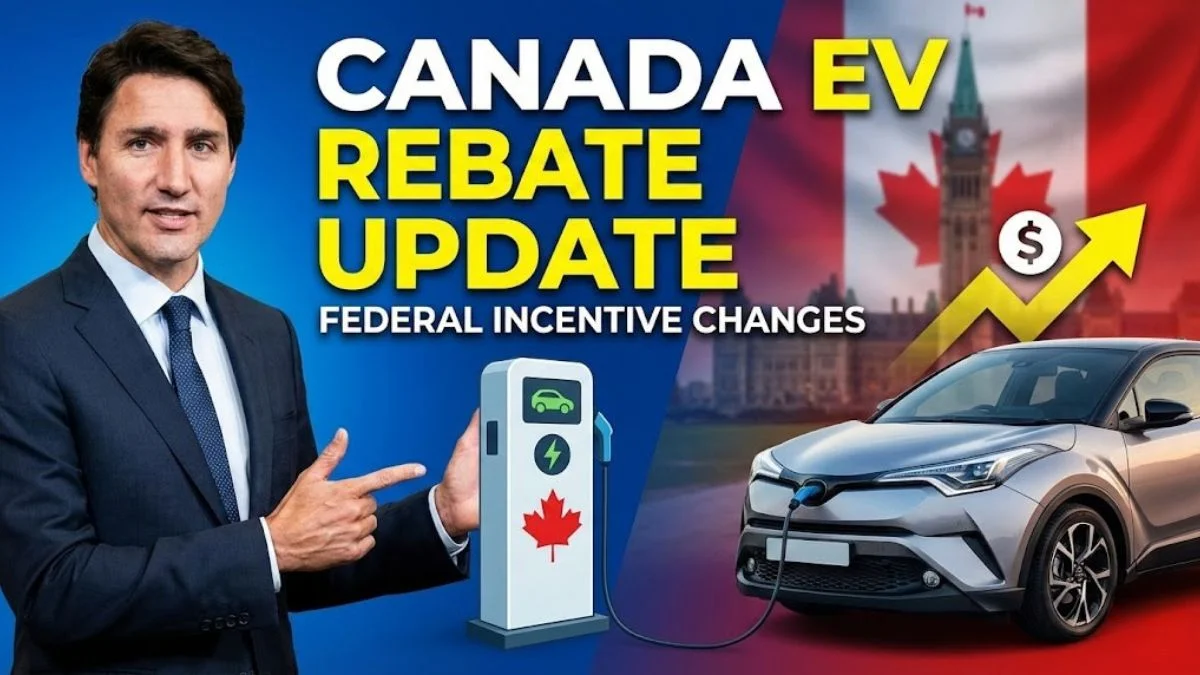
The landscape for electric vehicle (EV) incentives in Canada has shifted significantly entering 2026. While the federal government remains committed to long-term decarbonization goals, the primary mechanism for consumer rebates has undergone a major transition.
Prospective buyers and industry stakeholders should note that the original federal purchase incentive for passenger vehicles has been officially paused, while new trade policies and commercial programs are taking center stage.
Also Read



Status of the Federal iZEV Program for Passenger Vehicles
As of early 2026, the Incentives for Zero-Emission Vehicles (iZEV) Program for light-duty passenger cars is no longer accepting new applications. According to Transport Canada, the program funds were fully committed as of January 12, 2025.
The government has confirmed that there is no additional funding allocated for the light-duty iZEV program in the 2025–2026 Main Estimates.
This means the $5,000 point-of-sale rebate that previously applied to battery-electric and long-range plug-in hybrid vehicles is currently unavailable at the federal level for individual consumers.
iMHZEV Program: Incentives for Business and Heavy-Duty Vehicles
While passenger vehicle rebates are paused, the federal government continues to support the commercial sector. The Incentives for Medium- and Heavy-Duty Zero-Emission Vehicles (iMHZEV) Program remains active and is scheduled to run until March 31, 2026, or until funding is exhausted.
Key details of the iMHZEV program include:
- Incentive Amounts: Businesses and organizations can receive up to $200,000 per eligible vehicle.
- Eligibility: Applies to larger vehicles such as delivery vans, vocational trucks, and transit buses.
- Combined Savings: These incentives can often be stacked with provincial programs, covering up to 75% of the total purchase price.
New Trade Policies Replacing Direct Subsidies
In a strategic shift to improve EV affordability without relying solely on direct taxpayer subsidies, the Canadian government recently announced a major trade agreement. Effective in 2026, Canada has reduced its 100% tariff on Chinese-made electric vehicle imports to 6.1%.
This policy change includes an annual import quota starting at 49,000 EVs in 2026, which is expected to rise gradually to 70,000 by 2030. The goal of this measure is to diversify the supply chain and introduce more lower-cost EV models into the Canadian market to counteract the absence of the federal iZEV rebate.
Provincial and Territorial Rebate Overview
With the federal passenger rebate paused, consumers must now look to provincial programs for direct financial support. Availability varies significantly by region:
- British Columbia: The CleanBC Go Electric program continues to offer income-tested rebates of up to $4,000 for eligible new EVs.
- Quebec: The Roulez vert program is currently being phased out, with rebate amounts decreasing annually until the program concludes in 2027.
- Manitoba: Offers a post-purchase rebate of up to $4,000 for new EVs and $2,500 for used EVs until March 2026.
- Newfoundland and Labrador: Provides incentives of up to $2,500 for electric vehicles, available until March 15, 2026.
- Prince Edward Island: Offers up to $5,000 for new or used EVs, with additional bonuses for vehicle scrappage.
Regulatory Adjustments: The 2026 EV Sales Mandate
The federal government has also announced a 60-day review and a temporary pause on the 2026 Electric Vehicle Availability Standard (EVAS). Originally, this mandate required 20% of all new light-duty vehicle sales to be zero-emission by 2026.
This pause is intended to allow the automotive sector to adjust to changing trade dynamics and economic pressures while ensuring that consumer affordability remains a priority.
For the latest updates on eligible models and remaining commercial funds, users are encouraged to monitor the official iZEV and iMHZEV program pages.
Frequently Asked Questions
Is the $5,000 federal EV rebate still available in 2026?
No, the federal iZEV program for passenger vehicles was paused in January 2025 after all allocated funds were fully committed.
Which federal EV incentives are still active for 2026?
The iMHZEV program for medium- and heavy-duty commercial vehicles remains active until March 31, 2026, or until funds are depleted.
Are there any new programs to help make EVs cheaper in Canada?
The government has reduced tariffs on certain imported EVs to 6.1% to encourage a wider variety of lower-cost models in the Canadian market.

Ben Lee is a content writer specializing in government schemes and public benefit programs, delivering clear and up-to-date information to help readers understand eligibility, payments, and policy changes.