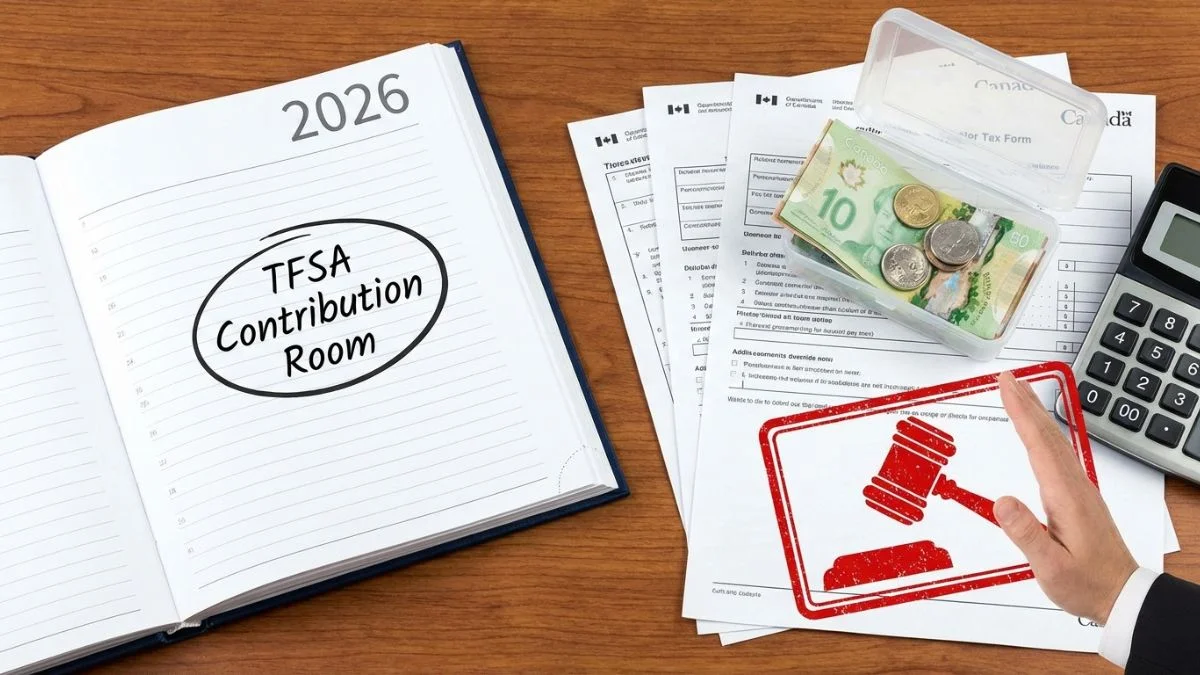
The Tax-Free Savings Account (TFSA) remains a cornerstone of financial planning for Canadians, offering a tax-sheltered environment for investments to grow. For the 2026 calendar year, the Canada Revenue Agency (CRA) has confirmed that the annual contribution limit is set at $7,000.
This mark stays consistent with the limits seen in 2024 and 2025, providing a predictable window for savers to maximize their accounts.
Also Read



While the annual limit is fixed, many Canadians find themselves facing unexpected penalties due to a misunderstanding of how contribution room is calculated. Navigating these rules requires a clear understanding of cumulative room, withdrawal resets, and the specific timing of re-contributions.
Understanding the 2026 TFSA Contribution Limit
The annual limit is indexed to inflation and rounded to the nearest $500. For 2026, the $7,000 addition brings the total cumulative contribution room to $109,000 for an individual who has been eligible since the program’s inception in 2009 and has never made a contribution.
Your personal contribution room is unique to your history. It is generally the sum of three distinct components:
- The current year’s annual limit ($7,000 for 2026).
- Any unused contribution room carried forward from previous years.
- The total amount of any withdrawals made in the previous year (2025).
How to Calculate Your Total Contribution Room Correctively
The most common error leading to tax penalties is over-estimating available room by looking at outdated figures. While the Canada Revenue Agency (CRA) provides a “My Account” portal to view your status, the information displayed in the early months of 2026 typically reflects data up to the end of 2024. Financial institutions are not required to report 2025 transactions until the end of February 2026, meaning your official CRA portal might not show the correct balance until April.
To stay compliant, you should maintain your own records of every deposit and withdrawal made throughout the year. If you are unsure of your lifetime limit, you can find the TFSA contribution room historical limits and sum them based on the years you were at least 18 years old and a resident of Canada.
Avoiding the 1% Monthly Over-contribution Penalty
The penalty for exceeding your TFSA limit is a tax of 1% per month on the highest excess amount. This penalty persists for every month the excess remains in the account. To avoid this, investors should be mindful of two specific scenarios:
The Re-contribution Rule: Timing is Key
If you withdraw $5,000 from your TFSA in June 2026, you do not immediately get that room back. That $5,000 is only added back to your available contribution room on January 1, 2027. If you attempt to “replace” that money in August 2026 without having other unused room available, the CRA will treat it as a new contribution, potentially leading to an over-contribution.
Tracking Room Across Multiple Accounts
Many Canadians hold TFSAs at different banks. It is vital to remember that your contribution limit is a total across all accounts, not a limit per account. A $7,000 deposit into a high-interest TFSA and another $7,000 into a TFSA brokerage account in the same year would result in a $7,000 over-contribution.
Important Eligibility and Residency Rules
To earn contribution room for 2026, you must meet the following official criteria:
- Be at least 18 years of age (room is granted for the full year you turn 18).
- Have a valid Social Insurance Number (SIN).
- Be a resident of Canada for tax purposes.
If you become a non-resident of Canada, you can keep your TFSA and no tax will apply to earnings in the account or withdrawals. However, any contributions made while you are a non-resident will be subject to a 1% penalty tax per month. Furthermore, no contribution room is earned for any year throughout which you are a non-resident.
Best Practices for 2026
To use your TFSA effectively this year, consider making your contributions as early as possible to maximize the time for tax-free compounding. If you need to move funds between different TFSA accounts, always request a direct transfer between financial institutions rather than withdrawing the cash yourself. Direct transfers do not affect your contribution room and prevent the risk of accidental over-contribution.
FAQs
What is the TFSA contribution limit for 2026?
The annual TFSA contribution limit for 2026 is $7,000, which is the same as the limits for 2024 and 2025.
Can I replace a withdrawal I made earlier this year?
You can only replace a withdrawal in the same calendar year if you have enough unused contribution room; otherwise, you must wait until January 1 of the following year.
What is the penalty for over-contributing to a TFSA?
The CRA charges a 1% monthly tax on the highest excess amount in your TFSA for every month that the over-contribution remains in the account.

Ben Lee is a content writer specializing in government schemes and public benefit programs, delivering clear and up-to-date information to help readers understand eligibility, payments, and policy changes.